
Telecommunications towers are essential structures to ensure that the signal reaches users with quality, providing broad coverage, stability and network reliability.
QMC’s Built-to-Suit solutions are custom-designed for each client and cover all project stages: site prospecting and evaluation, obtaining licenses and permits, engineering, construction and maintenance.
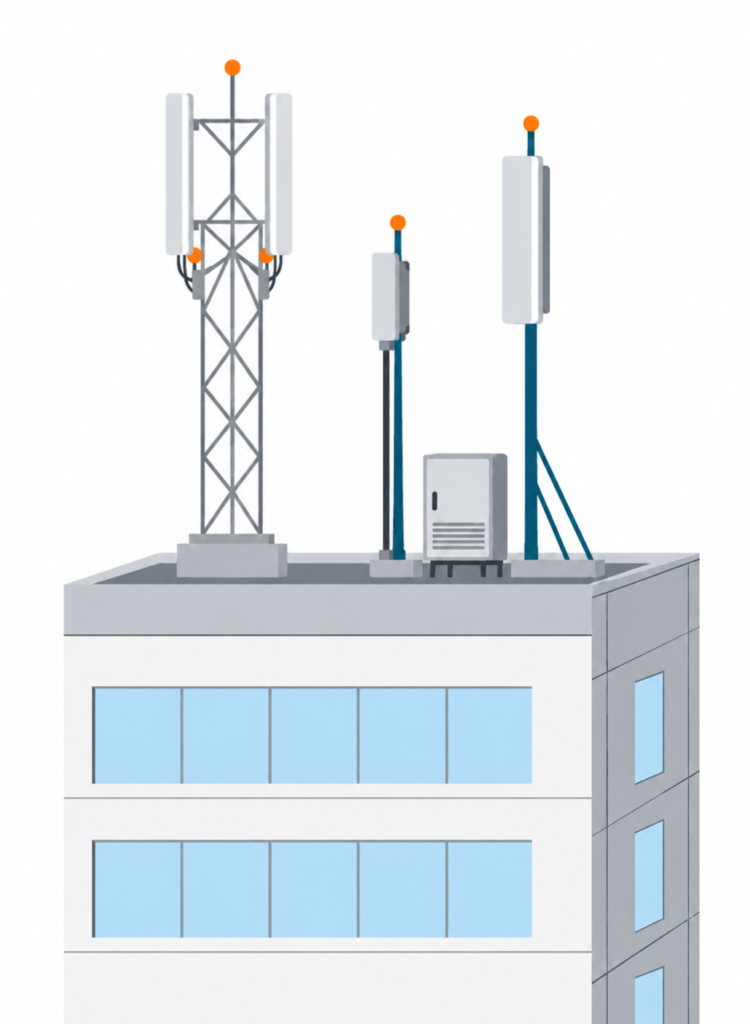
QMC develops infrastructure solutions on building rooftops, widely used in urban areas.
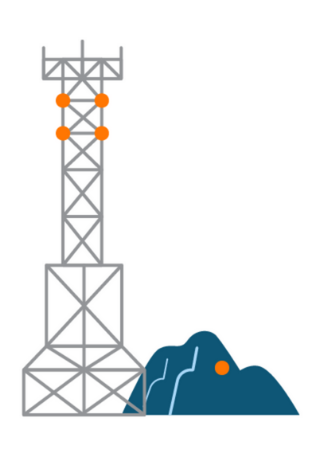
Special sites are solutions designed for locations with deployment restrictions and greater aesthetic sensitivity — such as areas with environmental, aesthetic, municipal, or historical heritage limitations — where it is very challenging to develop any infrastructure solution.
QMC has extensive expertise in special sites, having deployed more than 300 across Latin America — many in locations where other solutions had been attempted unsuccessfully for years.

According to the World Health Organization (WHO), there is no evidence that cell antennas cause cancer. The largest study ever conducted on the subject shows that signals emitted by cell phones and antennas are not strong enough to cause the disease.
Experts explain that the waves emitted are classified as non-ionizing radiation, meaning they do not have the energy to cause changes in the human body. According to organizations such as the American Cancer Society and the National Cancer Institute, only very high and out-of-standard exposures, different from those emitted by antennas and cell phones, could pose any risk.
No. A cell tower is a metallic or concrete structure that physically supports an antenna at a higher altitude than the ground. The antenna is the device that captures aerially transmitted cellular signal and distributes it throughout the telecommunications network. Many antennas, especially in urban areas, do not even require a tower.
Yes. Without the antenna, there is no signal, no service. There is no internet, no phone, no digital economy. Antennas bring connectivity and development to our daily lives.
We use technical criteria like signal strength and interference to obtain the best coverage. The more people using wireless services, the more demand there will be for antennas.
Two authorizations are required. The first is by the Federal Communications Commission (FCC), the body that oversees all activities in the telecommunications sector, including antennas. And the second authorization is up to local municipalities, who are responsible for ground regulations over the site where the antenna will be installed.
Yes! Every installation, whether in buildings or anywhere else, follows strict limits on signal strength in order to be authorized. Otherwise, the installation is not authorized by the FCC.
Yes. Antennas are installed so that there is a good service offering for the wireless consumer. If there’s an antenna near your home, it is because you need it to guarantee quality of service in that area.
Yes. Everyone today wants to access the internet and use their cell phone. So having mobile service at work or close to home is increases a property’s value.
Yes. Antennas emit non-ionizing electromagnetic waves. The intensity of these waves is much less than that of radio and TV antennas. This means that the antenna signal does not have the power to alter the molecular structure of humans or animals, and therefore, it does not interfere with people’s health.
Yes, antennas are safe to human health. Several studies have been carried out in recent decades, including by the World Health Organization, and none of them has proven that cell phones or their antennas are harmful to health.
Any and all wireless communication, whether Wi-Fi, radio, TV or cell phone, uses non-ionizing electromagnetic waves. There are WHO recommendations for wave emission limits that are followed by manufacturers. Like antennas, cell phones do no harm.
Some cities have a lot of bureaucracy and outdated laws for installing antennas, which have not kept pace with the development of new technologies or the growing demand for new services (photos and videos). In cities with these laws, the quality of telephone and internet services is compromised, harming the community.
The work lasts according to the type of infrastructure. For a camouflaged pole, the work lasts 30 to 60 days depending on the height and conditions of the ground. For façade work, the time required is typically shorter, depending on the adjustments that will be necessary and the type of camouflage. Anyway, when necessary, we present a project together with a schedule of works for approval.
In addition to the construction period, there are approximately 30 days to activate the equipment. During this period (work + activation), the movement of people may be significant; however, if necessary, all professionals who will have access to the work will be listed in an access list. After the construction phase, the flow of personnel to the establishment is lower and less frequent.
As a prerequisite, we emphasize leaving no negative visual impact on a site’s existing architecture.