
The use of smartphones and digital services has been growing continuously. According to Ericsson, we spend around 90% of our time indoors, where up to 80% of mobile data consumption takes place. This scenario reinforces the importance of indoor connectivity solutions, a trend that is expected to intensify as new applications and services demand greater network performance, capacity and quality.
In this context, connectivity is no longer solely the responsibility of carriers. Properties with poor connectivity end up having their reputation affected in the eyes of their visitors. Ensuring good-quality indoor connectivity is not just a differentiator — it is a strategic asset to enhance experience, productivity and reputation.
Indoor connectivity directly impacts:
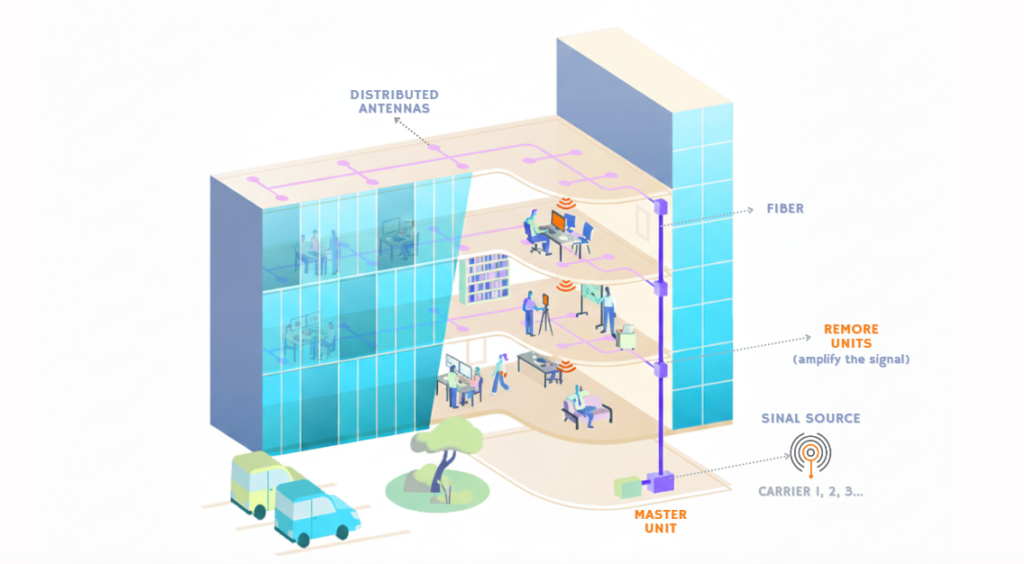
The DAS(Distributed Antenna System) is an infrastructure made up of small antennas distributed throughout the property and connected to the carriers’ network, ensuring strong and stable connectivity across all indoor environments without interfering with other systems or impacting aesthetics.
Imagine an environment where mobile signal works like electricity: available in every space, continuousl, reliably, and safely. That is the role of DAS.
Antennas are strategically positioned in high-traffic areas, corridors, basements, leisure areas, and other locations where the outdoor signal lacks capacity and/or coverage.
As a result, customers, users, employees and technical teams benefit from reliable access to mobile connectivity and current and future technologies, from any carrier, across all areas of the property.
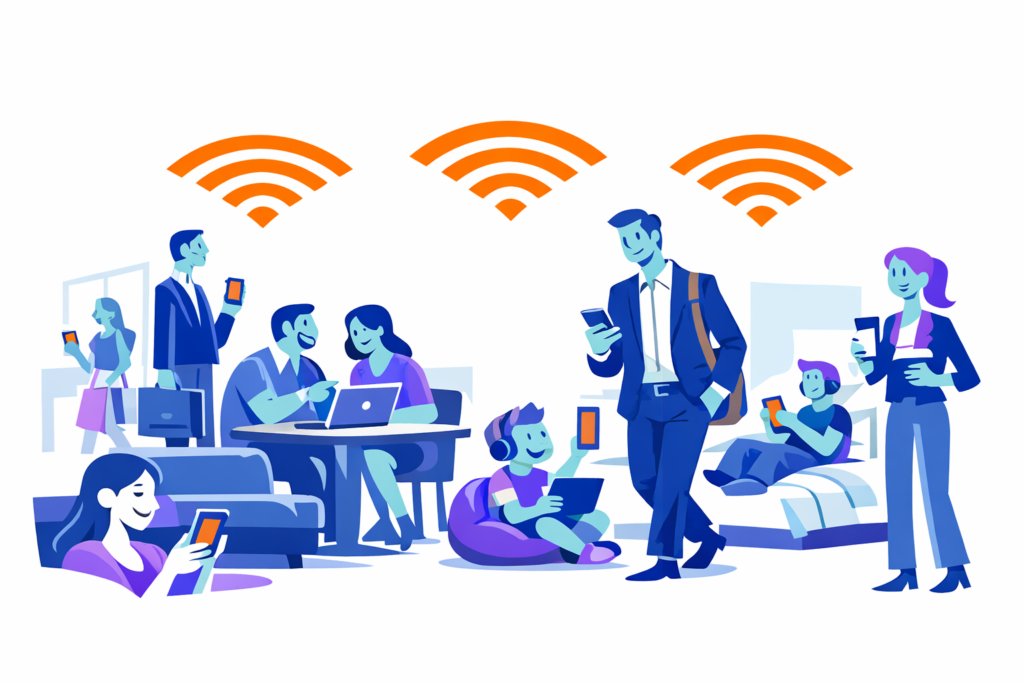
Wi-Fi and mobile networks do not compete — they complement each other to deliver a seamless connectivity experience.
Wi-Fi is efficient for daily use in indoor environments, supporting employees, corporate systems and data-intensive applications. Mobile networks, through solutions such as DAS, ensure continuous connectivity, providing a stable signal for calls, messaging and internet access — regardless of the carrier and without the need for login or authentication.
This complementarity is especially important in high-traffic environments, where Wi-Fi may face congestion and instability due to a large number of simultaneous connections. By strengthening mobile connectivity (4G/5G), properties reduce dependence on a single network, improve service continuity and eliminate common friction points, such as the need to request passwords.
Together, Wi-Fi and mobile networks enable a robust and balanced connectivity strategy, prepared to support the growing demand for digital services.
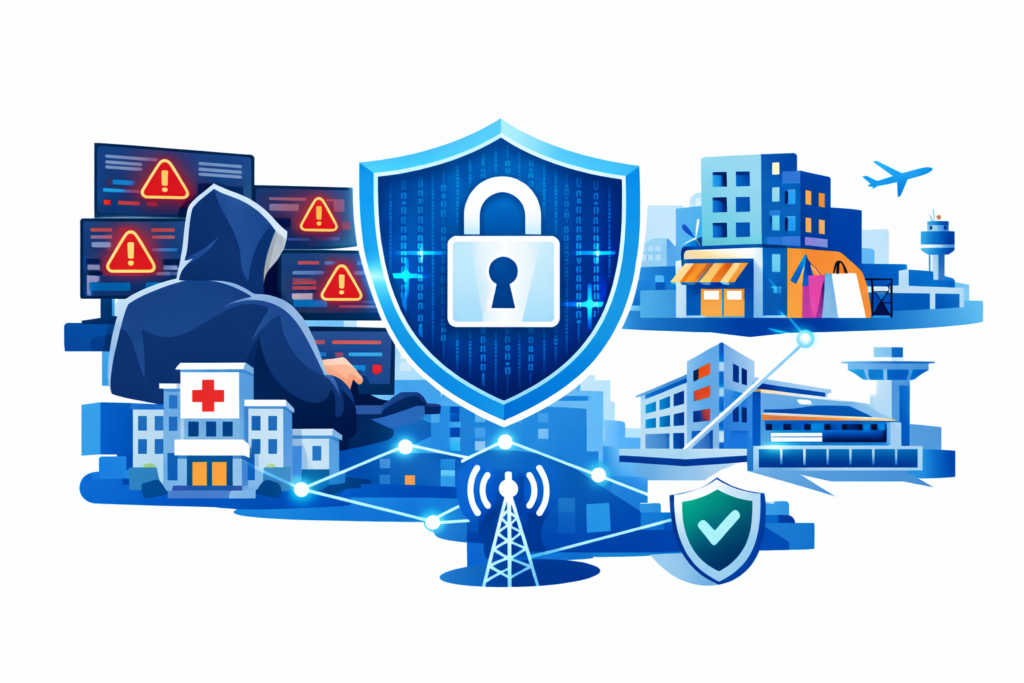
Beyond increasing traffic, digital security has become a critical challenge for organisations of all sizes. According to a Kaspersky report, between August 2024 and June 2025, Brazil recorded 549,000 blocked ransomware attack attempts, ranking first in Latin America for this type of threat.
In this context, leveraging connectivity solutions based on mobile networks — protected by the rigorous security layers of carriers — helps reduce vulnerabilities and enhance the resilience of digital environments.
Total coverage, including in the most challenging areas
DAS ensures stable cell signal even in basements, interior corridors, technical areas, and locations where the external signal normally does not reach, eliminating so-called “dead zones.”
Security and experience superior to Wi-Fi
Unlike shared Wi-Fi networks, mobile connectivity distributed through DAS requires no authentication, logins, or passwords, offering a simple, continuous, and uninterrupted experience for customers, visitors, and users. In addition, DAS operates under mobile carriers’ security layers, reducing risks of intrusions, data breaches, and access failures, contributing to a safer and more reliable environment for people and operations.
Zero CAPEX for the property
QMC absorbs the entire infrastructure investment, avoiding any upfront expenditure by the property.
Multi-carrier and multi-technology (4G, 5G and future)
A single infrastructure can serve different carriers and technologies, ensuring cutting-edge connectivity for the property over the long term.
Scalable and ready for expansions
The system can be expanded in line with the property’s growth, increased foot traffic, or evolving data demand.
Reduction in operational costs
By decreasing dependence on local networks and intensive Wi-Fi support, DAS contributes to reducing operational costs and simplifying connectivity management for the property.
24/7 monitoring and predictive maintenance
With continuous monitoring through a proprietary Network Operations Center, network performance is tracked in real time, enabling preventive action and rapid resolution of any incidents.
Centralized relationship management
QMC takes full responsibility for the relationship with carriers, so the property only needs to deal with a single point of contact.
Covered square feet
Number of antennas

“QMC was the best choice to implement the DAS system to solve the communication issues that we had in our mall. Professionally done, without interference or unforeseen events, our clients now have a better connectivity experience.”
Ricardo González
Real Estate Asset Manager, Grupo Éxito

“We must always work to improve the quality of the guest experience. We do not want mobile signal to be the issue that makes the customer choose another destination over us. QMC helped us, through capillarity and flexibility, to achieve this goal.”
André Corcos
Infrastructure Director at Vila Galé Group

“The great advantage of having QMC as a partner is the ease of having a person on call to meet the client’s every need, without bureaucracy or infinite layers of customer support, in addition to its great technical know-how.”
Daniel Galante
General Director at São Paulo Expo
The implementation of a DAS project is complex, but QMC manages the project in stages so that the enterprise is impacted as little as possible. QMC’s DAS solutions mostly use fiber cabling, which is thinner and lighter and thus much easier to pass through structures. In addition, we work with flexible hours so that our customers’ day-to-day activities are preserved as much as possible.
Another important point to note is that throughout the implementation, QMC will be focused on ensuring that the completed DAS structure will not be noticeable to passersby. The antennas must respect the architectural style of the venue and blend in with the surrounding environment.
Yes. DAS is an investment in infrastructure and, as such, needs to stand the test of time. However, QMC includes the maintenance as part of its service offering. We commit to an SLA that meets the carriers’ stringent requirements, and in the event that there is an issue, QMC offers customers a 24-hour support team. Our constant and proactive monitoring reduces the chance of technical problems that require major maintenance.
No. QMC builds antenna systems to distribute cellular signal through voice and data. No Wi-Fi signal is transmitted through QMC antennas. At present, the signals transmitted are 2G (for voice) and 3G, 4G and 5G (for data).
Not really. Macro cellular towers are still very important in the mobile connection ecosystem, and those towers contain antennas that emit signal over long distances. However, in the case of indoor venues, the most commonly used antennas are much smaller and more discreet. They are often attached to the ceiling and are smaller than a Wi-Fi access point. QMC’s DAS projects always take into account the aesthetics of the establishment so that we can make the antennas appear as minimally intrusive as possible.
An indoor system is necessary to prevent users from experiencing a drop in mobile signal and data performance. The mobile tower signal encounters two problems when trying to connect to devices inside a venue:
The antenna design suggested by QMC always requires approval by the venue owner before installation. This includes the number of antennas, their location and aesthetics. QMC makes the project as flexible as possible, so long as it does not compromise the quality of the system, in order to fit in with the existing aesthetics of the establishment.
In most cases this will be necessary for us to run cables through the ceiling. However, the QMC team always respects the hours that the venue owner makes the facility available to us. QMC adapts to your needs to minimize the impact on everyone involved and avoid jeopardizing day-to-day operations. The result of our implementations is not visible to you or your venue guests.
No. Our systems are designed such that all antennas receive signal from several operators, similar to the way a 24-hour ATM works for multiple banks.
Operators integrate their signal source equipment into the system built by QMC (usually in a specific head-end room within each project). All the operators need to do is connect a cable into our network and from that moment on the signal is released throughout the establishment.
QMC specializes in the infrastructure market: we build infrastructure in 5 countries and we have partnerships with all major local operators. All of our systems are built to accommodate all operators, which means that it is not necessary to have separate deployments for each operator or to juggle multiple parties (often with competing interests).
QMC interfaces with operators when necessary (not constantly) and is responsible for all maintenance. Imagine having a problem on the network and having to call all operators to figure out where the problem is. By working with QMC, you can focus on your core business and do not have to manage the entire relationship with the operators. This is all in addition to receiving dedicated customer service from QMC.
QMC is fully responsible for the maintenance and upkeep of the room in which our equipment is installed.
The short answer is no – in most cases the antenna has its own signal, not a repeater.
QMC does not collect data from any consumer. We are a company that builds infrastructure – the bridge between establishments and operators. We do not have access to any data from users’ mobile phones and we do not have the capabilities to collect data from consumers.
No. QMC only emits signal by building systems that connect to the systems of mobile operators. Information security is a responsibility that rests with the operators.